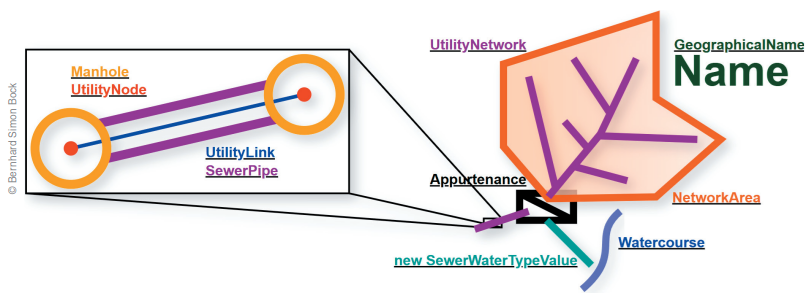
In WASSER UND ABFALL (Water and Waste), the journal of the German organisation BWK (Association of Engineers for Water Management, Waste Management and Land Improvement) integrated urban wastewater management plans – required under UWWTD (Urban Wastewater Treatment Directive) – should be standardised across the EU and created digitally to ensure consistent implementation throughout the EU. INSPIRE can effectively represent these plans in a data model to generate graphical plans based on it. Article 5 of EU Directive 2024/3019 of 27 November 2024 on the treatment of urban wastewater requires the preparation of Integrated urban wastewater management plans. The directive does not define the form of these plans. EU-wide consistency requires common guidelines for machine-readable data used to generate readable plans. A standardised digital process across Europe would therefore be beneficial.
Under the UWWTD, integrated urban wastewater management plans will be required for large networks (>100,000 PE) from 2033. Preparing these plans requires early action and a harmonised data standard, such as the EU INSPIRE Directive. INSPIRE, established in 2007, provides a Europe-wide framework for spatial data and has already been transposed into national law by Member States. It therefore makes sense to link the two directives. This article shows how the two directives can be effectively linked.